In Association with

Only a sliver of humanity is wired for kitchen life — those fuelled by obsession, purpose and the thrill of feeding strangers night after night. Everyone else burns out. The Food Network fantasy of becoming the next Gordon Ramsay evaporates the moment reality hits: 70-hour weeks, thin margins and exhaustion that rivals medical residency. A few cooks, though, don’t flinch — they accelerate. Victoria Rinsma is one of them.
At 28, the sous-chef at Hexagon — a modern Mexican restaurant in Oakville with one Michelin star — has muscled her way through the industry’s gauntlet and into Milan, where 15 of the world’s sharpest young cooks are competing at the S.Pellegrino Young Chef Academy global finals. The biannual competition is part school, part talent hunt, part pressure cooker. Hundreds enter; one emerges. Over two days, each chef presents a signature dish to a jury of industry heavyweights with palates calibrated to detect a missing pinch of salt at 20 paces.
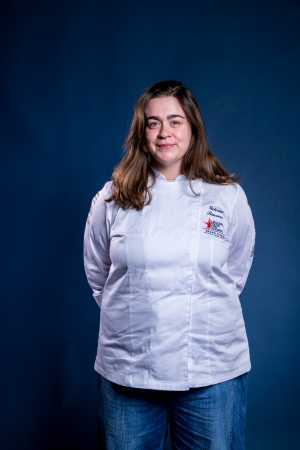
Victoria Rinsma, representing Canada at the S. Pellegrino Young Chef Competition in Milan
Mentorship is supposed to level the playing field. Most finalists are paired with a regional-jury chef. Rinsma’s mentor, though, is no assigned stranger. It’s Rafa Covarrubias — her boss, friend and guide at Hexagon for the past eight years. He also competed in the 2020 edition and reached this same finale. “It feels full circle,” he says. “Five years ago, I was one of these young chefs. Now I’m guiding someone through it.”
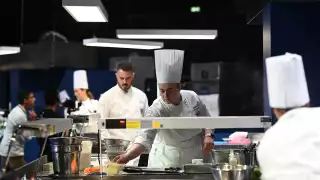
Inside a former Milanese airplane factory turned film studio, the finals look like an Iron Chef set on steroids: stainless-steel kitchens blazing, judges (all chefs from top restaurants) perched on a raised dais, a towering simulcast screen magnifying every hesitation, every tweezed microgreen.
Rinsma has a long time to watch all of it. It’s a warm, gold-lit day, but she hasn’t stepped outside since 8 a.m. Her turn is tomorrow. At first, being slotted near the end felt like punishment. “I just wanted to get it over with,” she says. But as hours creep by, she and Covarrubias start treating the competition like game tape — rewinding, analyzing, adjusting expectations. “Seeing it all play out… it helps,” she says. “You understand the energy. You understand what you’re walking into tomorrow.”
Across the room, finalists cook, refine and rehearse. Sugar-cane smoke drifts off one station; a plume of mirabelle plum rises from another. Pig ears simmer. Artichokes steam. Heat, spice, rendering duck fat and the low thrum of induction burners merge into one sensory haze. At 11 a.m., judging begins — plate after plate floating toward the dais in relentless succession.
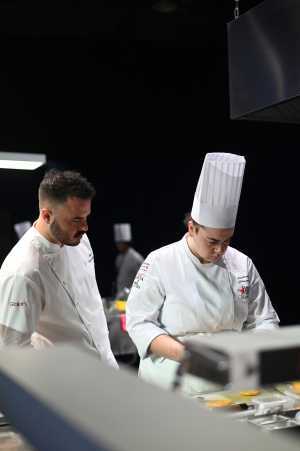
Victoria Rinsma and mentor Rafa Covarrubias work side-by-side at the The S. Pellegrino Young Chef Competition
Each hopeful gets exactly 15 minutes to serve the judges, present the story behind their dish and field whatever curveball questions the judges lob back. Cooking, for these finalists, is the easy part. You see it in their hands — steady at the stove, trembling at the mic. The competition rests on three pillars: technical skill, creativity and storytelling. In practice, though, the panel splits into two camps: a few listen for the story; most lock onto the plate.
San Pellegrino’s judging rubric says one thing. Chefs, though, will judge like chefs. Jason Bangerter, who judged the Canadian regionals, gets it. “These young chefs, they’re all just so good,” he says. “At this level, the differences come down to the smallest details — restraint, harmony, emotional clarity. Victoria has all that.” Bangerter had originally been tapped to mentor her, and though Covarrubias ultimately filled that role — at Rinsma’s request — he still flew to Milan to cheer on the Canadian prodigy.
View on Instagram
Covarrubias is the first to admit he’s biased, but his bias happens to line up with Bangerter’s. “Her food is honest,” Covarrubia says. “Punchy but delicate, feminine and beautiful. I could see her dishes anywhere and know they were hers.” Canada has never taken home the gold in Milan, but both men quietly believe she could be the one to break the streak.
Rinsma’s dish, Across the Sea and Home Again, merges her Newfoundland roots with the technique she’s sharpened at Hexagon: a smoked ham-hock chawanmushi for her grandmother; dry-aged New Brunswick bass with nixtamalized squash and charred-chilli pil pil for her present. She and Covarrubias spent years fine-tuning both the flavours and the presentation. “When you look at this dish, it’s me — my technique, my story, everything I’ve learned,” she says.
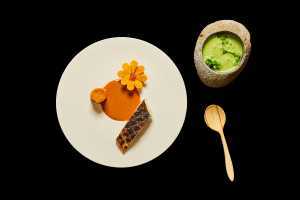
Victoria Rinsma's entry, “Across the Sea and Home Again”
Somewhere in the swirl of day one, Rinsma realizes — either in the moment or later, replaying it — that she’s stumbled into a Hallmark movie, a genre she consumes with PhD-level dedication. The beats are all there: no Canadian has ever won, no woman has ever won, and, as far as she knows, no former competitor has ever returned as a mentor by special exception. Momentum feels suspiciously aligned. “It felt like it was our year,” she says. “Like everything was lining up.”
Which is why the next day hits so hard.
Wednesday starts in the dark. Rinsma has been half-awake since 2 a.m., convinced her alarm will betray her. After an hour, she gives up, showers, gels her bun to competition tightness and triple-checks the bags of tools she prepped the night before. By 5 a.m., she and Covarrubias are back inside the cavernous film studio. The ovens are silent; cameras still asleep; the air cold enough to bite.
Everyone gets the same five-hour cooking window, staggered so presentations fall like clockwork. Rinsma isn’t up until 8 a.m., leaving her with nothing but nerves and time. “The waiting was the hard part,” she says. “I knew once I was in the kitchen, I’d be fine.”
And she is. Once the apron goes on, everything snaps into place. She moves with a rhythm she didn’t fully expect — cooking, tasting, adjusting, the way she’s done countless times at Hexagon. Her slot is brutal: penultimate. The judges are palate-fatigued and visibly depleted. Second last means serving to tired tongues without the baked-in halo of being the final act.

Canadian writer Caroline Aksich poses in front of a sign in Milan at the The S. Pellegrino Young Chef Competition
By early afternoon, the judges have eaten through a parade of intensely personal, technique-heavy dishes and look nearly comatose. Yet when Rinsma’s plates land, the room seems to reboot. Judges lean in. Faces brighten. Praise comes fast: “perfect” chawanmushi, “brilliant” squash, fish cooked with such precision, multiple judges mention it separately. Then a tear — Elena Reygadas’s voice catching mid-question. Jeremy Chan later admits he almost cried, too. In a room where reactions are typically stoic, a tear is a marching band and confetti cannon.
What follows is a blur — applause, cameras, flashes, the next competitor already stepping up. As soon as attention shifts, Rinsma and Covarrubias slip outside for the first time since dawn. A thin rain falls — the slow, soaking kind — and the cold air gives her a moment to breathe. That’s when everything she’s carried for two years spills out in a long, shaking cry. “It was a huge release,” she says. “We’d been working on this for almost two years.”
There’s no time to linger. A quick lunch, then straight to Sforza Castle for the awards ceremony rehearsal. Only afterward does she get two hours to sprint to the hotel, shower, change and return.
By evening, the gentle drizzle has turned into a theatrical downpour — the exact kind of weather a Hallmark screenwriter would use to signal a twist. The gala under the stars has been relocated to a grand tent. Still beautiful, but not the alfresco castle fantasy she’d pictured. Up to this point, the competition has felt like a steady cue toward triumph. This beat is… off-script.
View on Instagram
Seated at a 40-person table of chefs, mentors and judges, she allows herself a small, careful hope. “I felt very good,” she says later. “I tried not to get my expectations too high, but yes — I felt good.”
Then the announcement comes. When Ardy Ferguson’s name is called, she applauds — steady, gracious — but the flicker of heartbreak is unmistakable. The judges had praised every element of her dish. She made people cry. And still, she leaves without a trophy.
In the days that follow, her mind keeps circling the same question. The judges offered no critique, no hint of what nudged the decision in a different direction. “I still wonder,” she says. “What was the thing I didn’t do? I wish I knew.”
A month later, she’s back at the pass at Hexagon and Milan has already softened into something dreamlike — brilliant, surreal, a little blurry. She may never understand why unanimous praise didn’t translate into a win. Others can theorize — palate fatigue, the brutal penultimate slot, judges who didn’t put much weight on presentation — but she doesn’t dwell. Simply making it to Milan feels like a win.
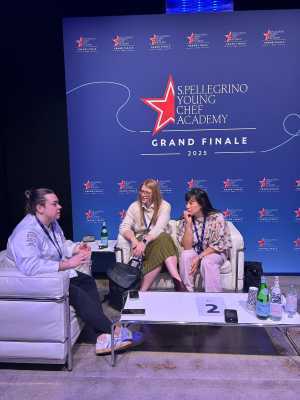
Victoria Rinsma chats onstage with writer Caroline Aksich and Canadian TV personality Pay Chen
She jokes that judging the S.Pellegrino Young Chef Academy would be nearly impossible — too subjective, too many brilliant-but-incomparable dishes. But that’s exactly what makes it compelling. “Everyone there is the best where they come from,” she says. “You’re judging 15 versions of excellence.”
And Milan taught her something else: A chef’s job in 2025 stretches far beyond the pass. Composure under cameras, clarity under pressure, the ability to talk about nixtamalization without sweating through your whites. These aren’t extras; they’re part of the craft, especially if you want to helm a three-Michelin-star kitchen or open your own place. Rinsma didn’t take home gold, but she aced the parts she didn’t expect to: the storytelling, the presence, the soft skills modern chefdom demands.

Victoria Rinsma and Caroline Aksich hang out alongside a Toronto cohort in Milan, including chef Jason Bangerter
Every S.Pellegrino Young Chef Academy edition comes with a theme, and this year’s was Bring Your Future to the Table. Many competitors took it literally (hyperlocal ingredients, vegan pivots), but the future isn’t only about what’s in a dish; it also lives in how a chef communicates. We’ve entered an era where the post can matter as much as the plate. Likes turn into reservations, algorithms crown the next hot table, and a restaurant’s survival can hinge as much on the person at the pass as on whoever guards the Instagram password. A strange new reality for chefs — but one Rinsma already navigates with unnerving ease.
Milan wasn’t the finish line — it was the launchpad.
And the momentum carried straight through customs. Within a month of returning home, Rinsma and Covarrubias announced they were leaving Hexagon, their shared home base for eight years. Their next stop: 20 Victoria, the city’s one-Michelin-star darling and a proving ground for cooks on the ascent.
They didn’t bring home SPYCA gold in their respective years, but they’re now after a brighter trophy: star number two.