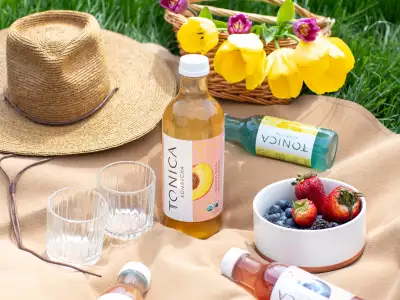
Fizzy, funky, fermented — there are a lot of buzzwords floating around about kombucha, but the general knowledge is still a little fuzzy. To demystify the drink, we've enlisted the help of Zoey Shamai, the founder of Tonica Kombucha, one of the first brands in Canada to bring the once home-brewed beverage to market.
As one of the founding members of the non-profit association Kombucha Brewers International, Shamai has helped champion a standard authentication seal for real, living kombucha made in the traditional way. Tonica Kombucha products carry the KBI seal and are certified organic, plus Tonica sells DIY Kombucha Kits for aspiring homebrewers who are looking for the next best thing since sourdough starters.
While studying yoga at an ashram in New Mexico, Shamai tried kombucha for the first time and was amazed by the digestive boost. “Everyone down there was fermenting kombucha. It was really cool,” she says. In a community that wasn’t drinking alcohol, brewing kombucha became popular. She kept making it and drinking it, and when she moved back to Toronto, she shared it with friends, family and her yoga students. “It just started organically, but the reason why was because I love it.”
Her goal was to create a kombucha that anyone could enjoy, and the result was Tonica, a flavour-forward, fizzy kombucha with a hint of sweetness and tang. Here, she gushes about her favourite beverage and why everyone should be drinking it.

Zoey Shamai, founder of Tonica Kombucha
Where does kombucha come from?
“Kombucha is a fermented tea that was first discovered in 221 B.C. in Asia. Eventually, the counterculture of the hippies found it and brought it over to North America, and people started to ferment it in their homes. Then the first brand emerged: GT’s [Kombucha] in the 1990s, and Tonica was the first brand in Canada, in 2006.”
What is kombucha?
“Kombucha is a culture made up of thousands of minuscule bacteria and yeast.”
How is it made?
“The first thing that you always do when you make kombucha is you have a caffeinated tea. It has to be caffeinated and a sugar base, like a sweet black tea. The tea and the sugar are metabolized by the kombucha culture, and it creates the byproducts, some of which are living enzymes and a lot of beneficial acids that are really good for the liver.”
Is it alive?
“Raw kombucha is alive; Tonica is alive. The traditional way that kombucha was made was always so that it was alive. It was never pasteurized. You could never store kombucha in a sealed container, like a can or a bottle at room temperature, because it would continue to ferment and the gas that it produces would explode the can or the bottle.”
Do you have to keep it in the fridge?
“These days, there is a lot of marketing and green washing with some of the brands where they claim to be living, but they're shelf stable, which is impossible. You couldn't have a living fermentation in a sealed container at room temperature, so all living, real kombucha has to be in the fridge, because the fridge slows down that fermentation and almost puts the culture to sleep.”
What is SCOBY (symbiotic culture of bacteria and yeast)?
“It's a small barrier between what's happening with the fermentation and the air in the environment, so it seals off the kombucha to ferment faster. It looks really funky, and we do sell it as part of our DIY kit. But the most important thing is the starter that you're using, which is also in the kit, because it contains all of those tiny minuscule parts of what ends up being that SCOBY that we see.”
What are the benefits of drinking kombucha?
“The number-one reason why people want to drink kombucha is the digestive boost. When you drink it, the glucuronic acid binds to toxins in the body, and as you drink water, it'll flush out of your system. That's why so many people feel like they have amazing digestion, especially when they first start, because they're clearing all this literal crap out of their system.
“We know now that the gut is so connected to brain health and also all of the organs, and when the liver is assisted in cleaning out all that junk, it is able to renew the cells of the hair and skin.”
What are the benefits of buying it versus brewing it at home?
“I think convenience is the main factor for buying it in a store. Also, we've perfected the flavours.
“We launched our DIY kombucha kits, and it does take three to four weeks to get a really strong kombucha. Once you brew it at home, it's super fun to watch it and grow it, and it multiplies. So, you would buy one kit, and then you never have to buy another, because every time you brew it, you multiply.”
Why is it so popular now?
“I think it's because the aging population is more educated on how daily diet affects mental health and physical health. Before there was the buzzword of functional foods, people realized they needed to eat things every day that would be helpful for them. Kombucha had already established itself as this cool, niche beverage that tastes great because those of us who were in retail stores started to carbonate it and work on our flavour profiles.”
How often do you drink kombucha?
“I drink it every day. I drink Tonica, and I also have my home brew.”
Do you think more people should be drinking kombucha?
“I think everyone can benefit from it. There's something in our palate that fermented foods speak to that no other foods do, because it's like you're pre-digesting. It's bringing in something that's only aiding your body. And I think your body knows that. You see little kids try it, and they love it.”
Read more from The 50th Issue