I’ve never been to Greece, but Mamakas Taverna feels like home. Inside the humble building, guests relax into brown banquettes and shed the pretense of the cooler-than-you Ossington strip. A glowing mural of cartoon figures dance right out of a yaya’s house and onto the walls, landing across from art pieces only a grandmother would own.
“I wanted it to feel like you were eating in someone’s kitchen,” says Thanos Tripi, owner of Mamakas Taverna. “The first thing you do when you walk in is you see the kitchen, and that was intentional.”
On the back wall, an intricate, wood mirror reflects the whole scene: Guests are greeted by the sight of chefs grilling lamb chops in the open kitchen, before squeezing past the bar where kitchen cupboards are lined with Greek wine and glass bottles shimmering as blue as the Aegean. Exposed plates are piled beside glasses, while cups are slung from hooks underneath. It has all the buzzy warmth and organized clutter of a lived-in home.
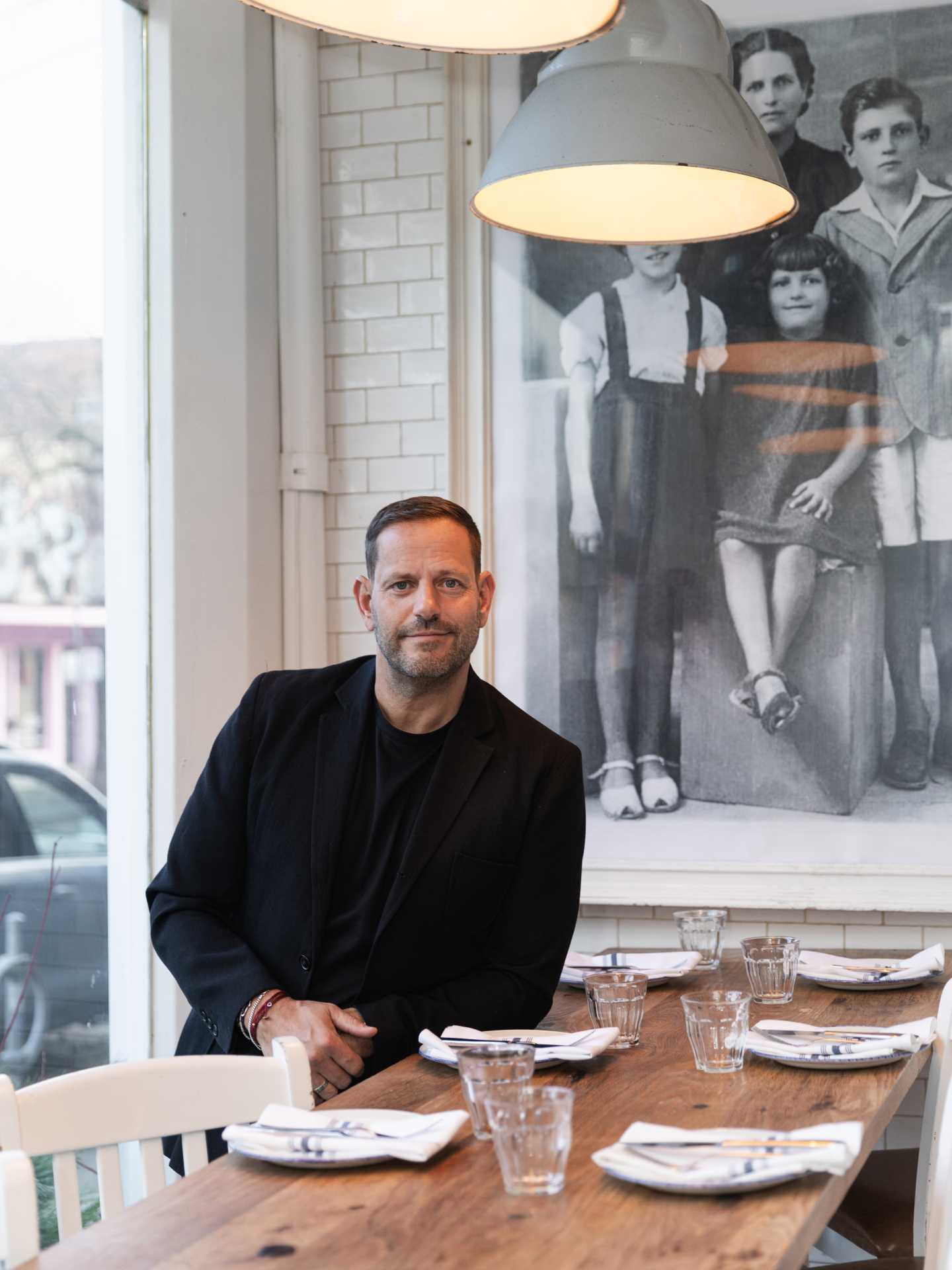
Thanos Tripi, owner of Mamakas Taverna
Rachel Simpson
For Tripi, Mamakas Taverna was a story of love at first sight that started over a decade ago. At a time when “you had to travel to the Danforth to experience great Greek food,” he saw a gap in the market. “Before we were a food group, Mamakas was an idea I had to bring Greek food, through my lens, to the west end,” he says. “I was driving up and down looking for the right space, and then I saw this little building. It was very indiscreet, on a corner; it was single-storey, and was all beaten up and old and tired, and I fell in love with it. It felt like something you would see in Greece,” says Tripi. “My idea was to build a very traditional-looking taverna juxtaposed against the backdrop of Ossington and the Queen West cool factor.”
After an extensive build, the empty space became Mamakas Taverna, the antithesis to the old-school Greek scene on the Danforth. With its youthful staff, DJ-curated soundtrack and hip location, Mamakas gave Greek food in Toronto a fresh face. “But more than anything, [I wanted to] focus on the quality of the food I grew up eating in Greece, and not a watered down, Americanized or Canadianized version of it,” says Tripi. “Traditionally, we don’t eat rice, potatoes and bread on one plate. That is something that happened here in North America.”
Meant for sharing, the dishes are simply constructed, allowing the marriage of local ingredients and Greek imports to shine. “If there’s an opportunity to save money and compromise product, we don’t even look at it. I never will,” says Tripi. “We really pride ourselves on the quality of food, where we’re sourcing it from and how we work with it.”
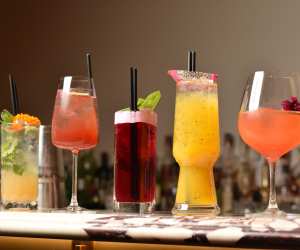
It wasn’t long before the demand for Mamakas outgrew the space, and Tripi opened Agora Greek Market on the other side of Trinity Bellwoods Park to churn out their house-made dips and pita. It was another huge renovation. “I swore I was never going to build another kitchen from scratch again after that,” says Tripi. But he didn’t stop there. When the opportunity came up to take over the space across from Mamakas, he opened Bar Koukla, a spot for cocktails, wine and snack plates, like you would find in Athens.
In Yorkville, a new Agora will offer a casual sit-down spot with wallet-friendly prices. Despite his promise, he’s once again building a whole new kitchen from scratch, this time for a new Mamakas in Summerhill.
It’s all based on what Tripi has learned through his own hands-on experience. During the pandemic, he took the wheel of his takeout business, hand-delivering food and discovering what and where people order.
Today, he’s still just as involved. Tripi gets his hands dirty in the production of the hand-picked, cold-pressed olive oil used in his restaurants. Every summer he goes back to Greece to spend time with family and do R&D, eating his way through the country and connecting with his suppliers.
“Every time I go, I come back with new ideas, inspiration and new products that I want to see on the menu here,” says Tripi. More than just a place to eat, Mamakas Taverna and Tripi’s other restaurants are an authentic showcase of the Greek culture he’s so immersed in — and he’s not slowing down.
Mamakas Taverna's most iconic dishes
House Dips and Pita
Carmen Cheung
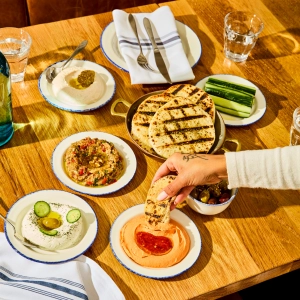
“In a taverna setting, we would start a meal with dips. We make tzatziki; taramosalata; tirokafteri, which is like a spicy feta dip; and melitzanosalata, which is our eggplant salad. The taramosalata is made with fish roe, potatoes and white onion. I grew up with my grandmother making the taramosalata. We pride ourselves on the one we make. It’s excellent. We use a white tarama, and it’s exceptional. It’s really bright, lemony, smooth and moussy.
"We import the roe from Greece. All of our yogurt is imported from Greece. All of our sheep’s milk feta is imported from Greece. And obviously, the olive oil we’re using is imported from Greece. We’re bringing in our own olive oil that we use in the restaurant now. As much as I can, I’m sourcing the best products from Greece . . . We make our own pita bread out of our Agora market.”
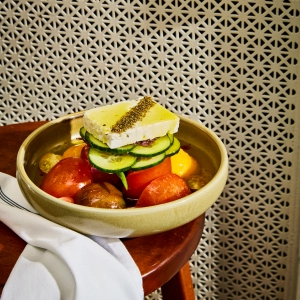
Horiátiki
Carmen Cheung
“The Horiátiki salad is our traditional Greek village salad. It’s mostly tomatoes, [with] cucumbers. We blitz our own kalamata olives to make a tapenade, so that when you break the feta cheese, and you break through the tomatoes and cucumbers, and you mix it all together with our unfiltered red wine vinegar and our house olive oil, the olive goes in everything. Like any salad, the best part of it is the bottom of the dish with the olive oil, red wine vinegar, tomato water and oregano.
"We get our tomatoes and we let them ripen here for about three to four days before we cut into them. We have a process that allows us to serve the salad through winter time without breaking our commitment to uncompromising quality.”
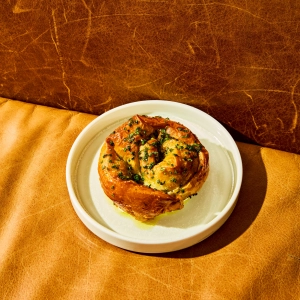
Spanakopita
Carmen Cheung
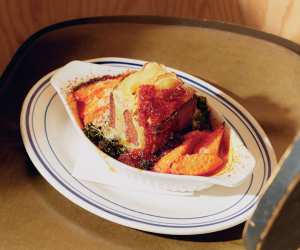
“Part of the genesis of this whole project was my aunt Barbara and her spanakopita. Whenever we would go to my aunt’s gatherings for Greek Easter, Christmas, whatever it was, she was always cooking the spanakopita. It was always in more of the northern style, which was a spiral, called strifti. It was really important for me to have it on the menu because it just hit home for me on so many levels.
"We put it on a little bed of yogurt. We hand-make everything and hand-roll it here and then we drizzle some organic cream honey on top with fresh wild thyme. It’s really delicious, super crispy, and inside is Greek feta and spinach. Spanakopita is one of those things you find more at a grab-and-go bakery, and you eat it on the fly, not something traditionally that you eat in a restaurant, plated like that. But I decided to do it. It’s one of our top sellers.”
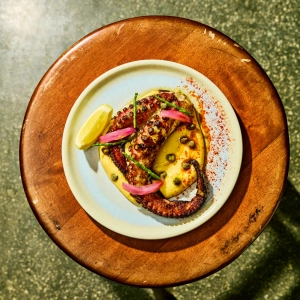
Oktapódi
Carmen Cheung
“The octopus, for me, is essential. I grew up with my uncle Nico teaching me how to hunt and how to look for the octopus, how they hide, and so we would do that together. He was a fisherman, and he also had a fish farm in Greece. So those elements bring back a lot of childhood memories for me, when seen on the table. The octopus was very important for me to deliver a true taverna experience.
“It’s a very traditional way of presenting it, although we definitely elevate it. It’s steamed in spices, and we grill it to order. It’s served on a bed of Santorini fava, which is a purée of a pulse. [It’s] not like Canadian fava; a Greek fava is more like a yellow split pea, but a lot more earthy, nuttier flavour. We serve it with capers, caper leaves and pickled onions, and then olive oil to finish, with a bit of paprika.
“The pickled onions cut through the richness of the fava and the octopus; it’s very nice. And the caper leaves add a very subtle briny flavour. It’s not as punchy as a caper; it’s more gentle and interesting.”
Paidákia
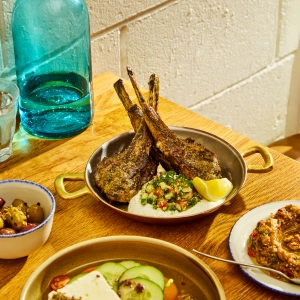
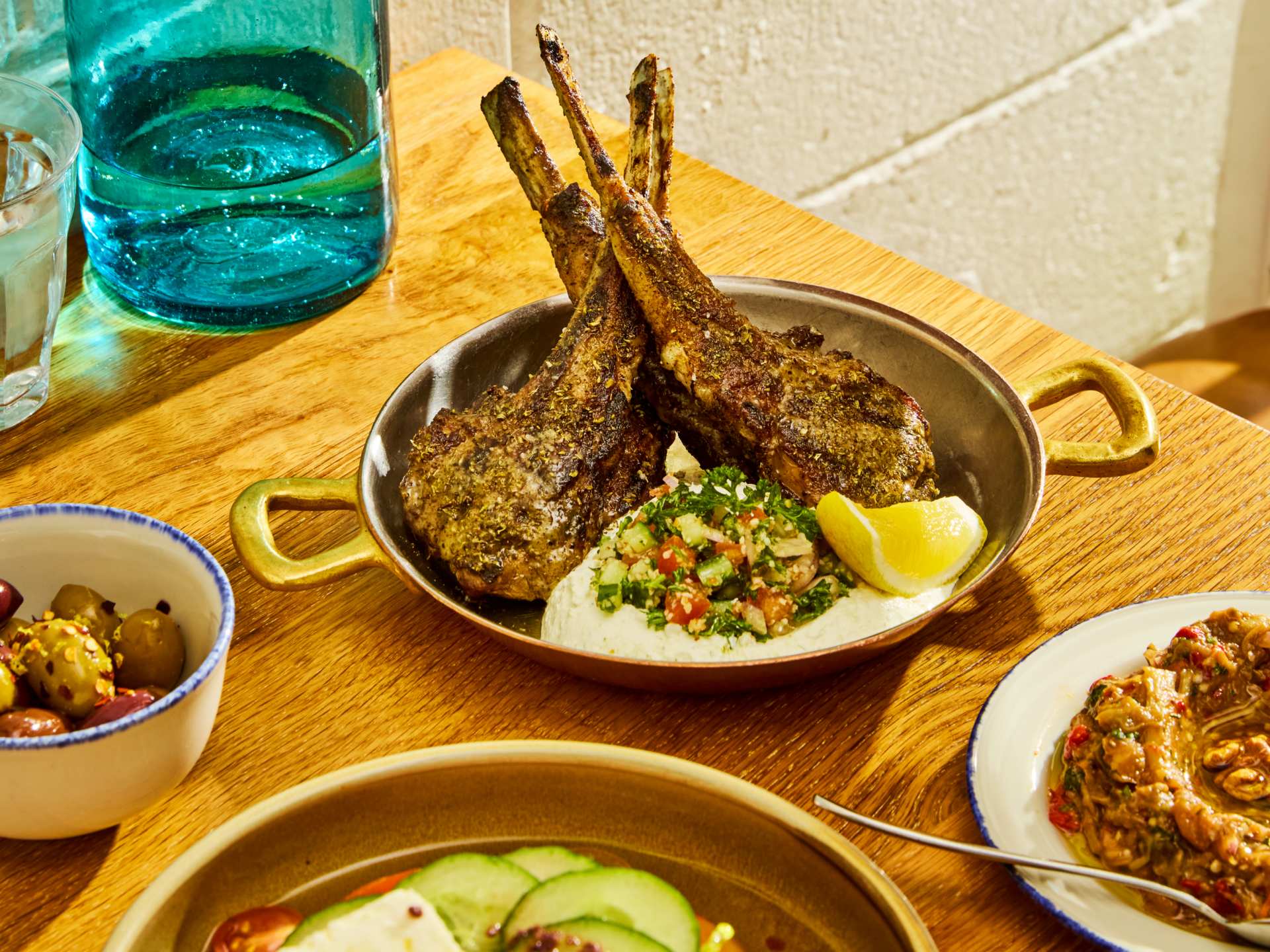
“Lamb chops, for us in Greek, ‘paidákia,’ are like chicken wings to North Americans. The lamb chops are very important and sort of define the quality of your [taverna], to me anyway. We use the finest lamb we can source, and we serve it with our house-made tzatziki, a little bit of a bulgur salad for some colour and freshness, and our ladolemono, which is a very traditional sauce that we make in Greece for basting meats and fish.
"The meat ladolemono has a little bit more depth to it, adding mustard. We toss our lamb chops in that, and we use wild oregano and Greek sea salt to finish. They’re really delicious. They’re tender. We leave the fat cap on to render, so there’s a lot of flavour. The dish is very simple, and it rests solely on the quality of your ingredients, as does Greek cuisine in general.”
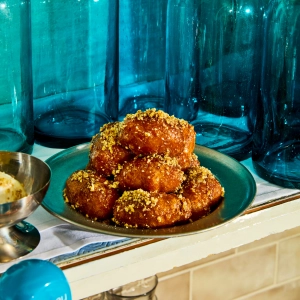
Loukoumades me Karydia
Carmen Cheung
“We call them our Greek honey balls. We make them to order. [They’re a] very traditional Greek dessert; they’re little doughnuts. We do them à la minute, and we put a very high-quality Greek honey on top and toss them. It’s not a sugared syrup, which you find more often. They’re very fresh, light, delicious and served with our very own milk and honey ice cream.”
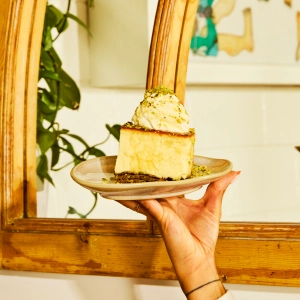
Baklava Cheesecake
Carmen Cheung
“Our baklava cheesecake has become quite iconic. It’s a large portion. It’s interesting because the Greeks invented the cheesecake, believe it or not. We wanted to incorporate something of ancient tradition, in a new way, and we came up with the baklava cheesecake. It’s layered baklava, nuts and spices on the bottom of a filo pastry with a feta cheesecake. We add orange blossom and rose water to it as well. It’s very aromatic, has a lot of personality. It’s delicious.”